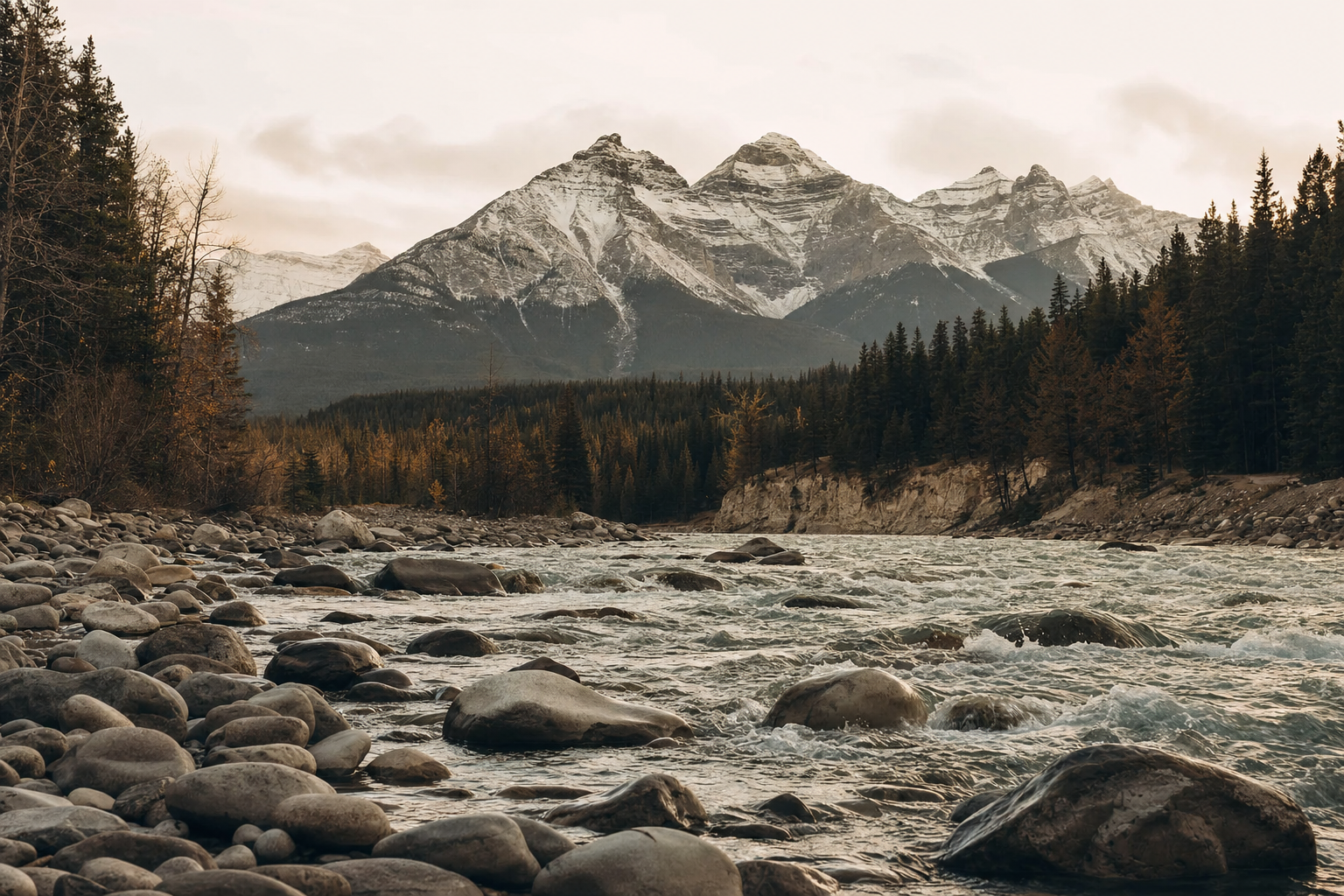
The Bow River moves through the Bow Valley with an authority that takes some people years to notice. Not because it is hidden - it is right there, running beside the highway from Banff to Canmore, visible from the road and from the trail and from the back decks of the condos that have multiplied along its banks over the past two decades. But visible and noticed are not the same thing, and the river does not insist.
I have been guiding groups through this corridor for seven years. Before that I worked a desk job in Calgary, which I left not dramatically but gradually, the way a relationship ends - through accumulated evidence that I was somewhere I did not belong. I came to Canmore because the mountains were there and I needed them to be there. I stayed because the work of guiding turned out to be the closest thing I had found to the kind of attention I actually wanted to practice.
Guiding is, at its core, a practice in directed awareness. You cannot lead people safely through moving water or exposed terrain without tracking a great deal of information simultaneously - the weather, the group's energy and capability, the condition of the trail, the subtle shifts in the river's character as flow varies between seasons and hours. You develop, over years, a form of attention that is both broad and fine-grained. Wide enough to catch early signals of changing conditions. Specific enough to read individual faces for signs of cold or fear before they declare themselves.
"Visible and noticed are not the same thing, and the river does not insist."
What Moving Water Teaches
I have watched hundreds of people encounter the Bow River for the first time. There is a common pattern in how people who spend most of their lives indoors relate to running water. They look at it. They may take a photograph. They appreciate the scenery in the way that scenery gets appreciated - as a backdrop to the walk, pleasant and confirming. Then they move on.
What they rarely do is listen. Not in the metaphorical sense, but literally. The Bow has a sound that is more complex than it appears - different frequencies layered over one another, varying with depth and volume and the character of the riverbed. The deep tone of water moving over large boulders is nothing like the higher register of a riffle crossing a gravel bar. A skilled paddler can read a river's acoustic character from fifty metres and understand something true about what the water is doing before it comes into view.
This kind of listening is learnable, but it requires a prior step that most people skip: the decision to be present enough that learning is actually possible. Not present in the aspirational sense. Present in the literal sense of having your attention available and directed outward rather than running on the continuous loop of internal commentary that most of us maintain throughout our waking hours.
Solitude and What It Costs
One of the things that wilderness guiding has given me is a high tolerance for solitude, which I have come to think of as a skill rather than a temperament. The valley in February, when the tourist season is over and most of the day-hikers have returned to the cities, has a quality of silence that is not empty but full - full of the sounds that get covered over the rest of the year by the noise of company.
I spend time alone in the backcountry regularly, and the first day of any extended solo trip is always uncomfortable in the same way. The internal monologue, deprived of the social audience it usually performs for, turns self-critical. Without the presence of other people to organize your behaviour around, the question of what you actually want to do - rather than what you present yourself as wanting to do - becomes harder to avoid. This is not pleasant, but I have come to believe it is necessary.
The river is useful precisely because it is indifferent. It does not respond to performance. It does not reward appearing engaged over being engaged. It is doing exactly what it is doing, at the speed the gradient demands and in the shape that the valley gives it, and if you want to understand it, you have to meet it where it actually is.
Presence as Practice
The people I have guided who get the most from time in this landscape are rarely the ones who arrive with the most experience. They are the ones who arrive with what I think of as a willingness to be wrong about where they are. They hold their expectations loosely enough that the actual valley can correct them. They are curious rather than confirmatory - looking for what is true rather than looking for evidence of what they already believe.
This is harder than it sounds. Most of us have strong prior models of what nature is supposed to feel like and what it is supposed to do for us. We arrive at a river having been told it will be restorative, or clarifying, or peaceful, and we try to have the experience we have been promised. When the river does not produce the expected effect on schedule - when it is cold and loud and indifferent and we are still carrying whatever we came with - the tendency is to blame the setting rather than the expectations.
The skill is in learning to stop expecting the landscape to produce a specific outcome and starting to simply pay attention to what is actually there. The Bow River in early May, when the snowmelt is running at its highest volume and the water is a cold, opaque grey-green, moving fast enough that you can hear it from the road, is not peaceful in any conventional sense. It is powerful and slightly alarming and absolutely present. That presence is contagious, if you let it be. You stop thinking about what you are supposed to feel and start noticing what you actually feel, and the gap between those two things is where something honest can begin.
That is what the water teaches, given enough time and enough attention: that the world is not performing for you. It is simply doing what it is doing. And there is something genuinely steadying about that, once you stop needing it to be otherwise.
Author
Julia Chen
Canmore, AB
Julia Chen is a wilderness guide and outdoor writer based in the Bow Valley. She leads backcountry groups through the mountain wilderness and writes about what sustained attention to wild places demands, and what it returns.
More from Julia Chen