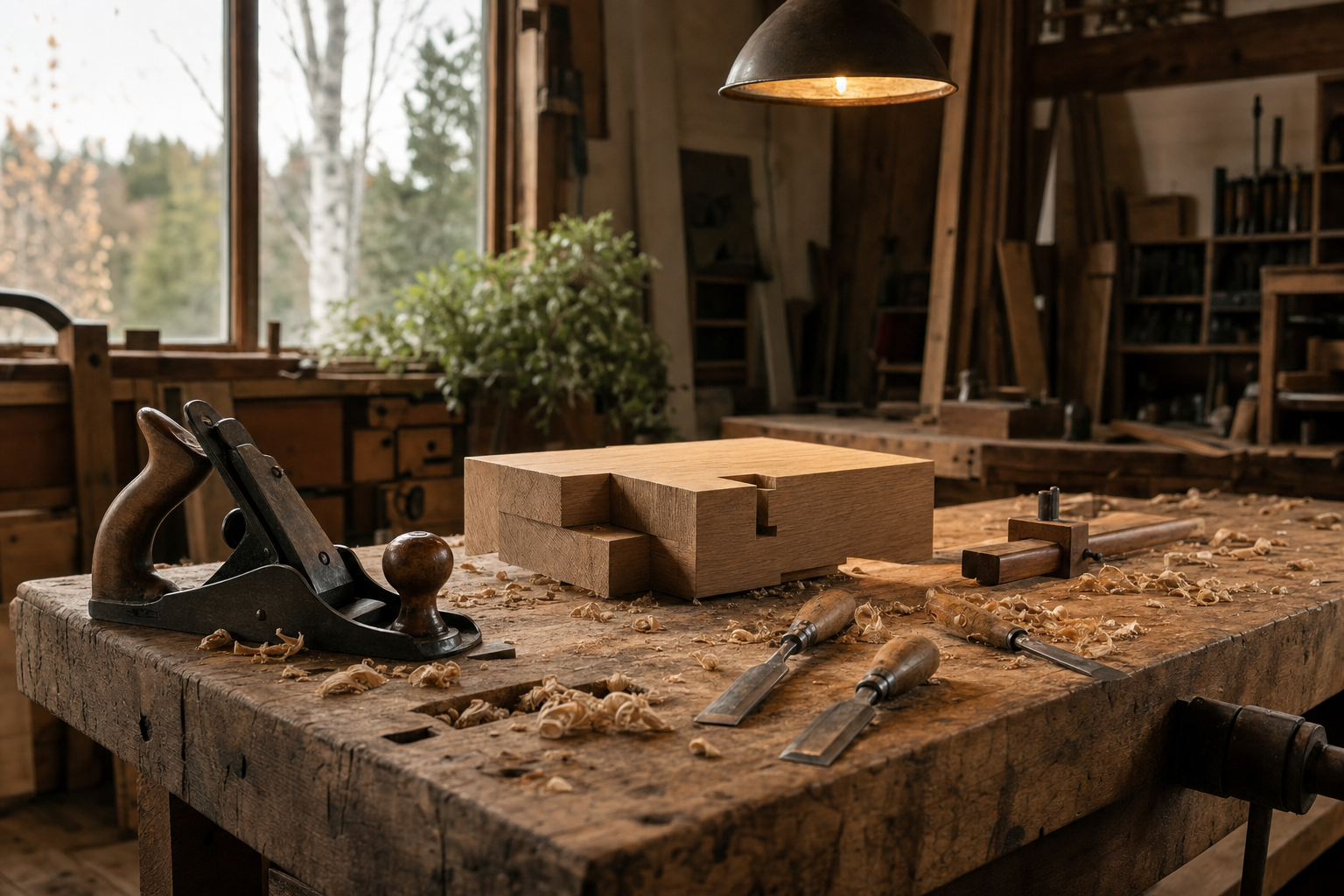
The first time I tried to cut a mortise by hand, I split the workpiece. Not at the end of a long session when I was tired and had lost focus. At the beginning, with fresh eyes and careful intentions, after reading the relevant chapter twice and watching three hours of instructional video. The chisel slipped and the oak split along the grain in a line that rendered eight hours of preparation useless.
I put the chisel down and stood in my workshop - a converted utility room in my house in Halifax's north end - and tried to understand what had happened. The motion had looked right. The angle had matched the video. The chisel was sharp. Everything that could be checked in advance had been checked. And yet the wood had its own opinion about the matter, and it was not interested in my preparation.
I had spent eleven years as a software engineering lead. In that world, if you understood the system thoroughly enough, you could predict its behaviour. Bugs were failures of understanding, but understanding was, in principle, achievable. The computer was not indifferent. It did exactly what you told it. The errors were always yours, but they were also, with sufficient care, correctable.
Wood is different. Wood has already lived a life.
"The computer was not indifferent. It did exactly what you told it. Wood is different. Wood has already lived a life."
What the Material Teaches
When I decided to leave my position at the software company, I did not have a plan. I had a feeling, increasingly insistent, that I had built a career that ran on a kind of intelligence I did not fully respect anymore. Everything I was good at was fast and abstract. I could hold complex systems in my head, find failure modes in architecture diagrams, communicate technical decisions to non-technical stakeholders. All useful things. All things that happened at a remove from anything physical and permanent.
I started woodworking the way most people do: with a weekend course at a community centre, a starter set of chisels, and the belief that skill was mainly a matter of technique. You learned the correct technique, you applied it, the results followed. This is not wrong, exactly. But it is incomplete in a way I did not understand until the wood started pushing back.
The thing that hard materials teach, that I have not found teachable by other means, is the difference between knowing something and knowing it in your hands. I knew how to set a plane's blade to the correct depth. I had read about it and understood the principle. But for months my shavings were too thick or too thin, the surface left either torn or barely touched. The knowledge was in my head. The skill was not yet in my hands. And there is no shortcut between those two states. There is only time, and repetition, and the willingness to fail at the same task enough times that your nervous system gradually learns what your intellect already understood.
The Body's Intelligence
I have come to believe that there is a kind of intelligence stored in the body that is genuinely separate from what we typically mean by thinking - what philosophers call tacit knowledge. It is not intuition in the mystical sense. It is more like compressed experience - a record of thousands of small adjustments and corrections that have accumulated into something that feels like instinct but is actually learning.
When a carpenter with thirty years of experience runs a hand along a board before cutting it, she is reading the wood's character - grain direction, figure, the particular density and resilience of this piece rather than the abstract category it belongs to. She is doing something that looks like a casual gesture but is actually an act of sophisticated analysis, performed by a body that has catalogued enough examples to recognize variations that beginner eyes would miss entirely.
I do not have thirty years yet. I have three. But I have enough accumulated time with the material to feel the difference between a tool that is working and one that is fighting the grain, and to make the small adjustments that bring it back into cooperation. This is the most honest kind of feedback I have ever received. The wood does not soften the message. It does not take into account my effort or my intentions. It simply shows you exactly where you are.
On Patience as Respect
There is a patience required by craft that is different from the patience required by other difficult things. It is not the patience of waiting. It is more like the patience of showing up. Every day, or as close to every day as you can manage, with the tools and the material and the willingness to be exactly as skilled as you currently are rather than as skilled as you want to be.
I have found this discipline harder to maintain than almost anything I did as a knowledge worker. In the office, there was always a way to compensate for a slow day - to skim through email, to take a meeting, to produce the appearance of progress without the substance. In the workshop, the wood will not accept substitutes. You either cut the joint cleanly or you do not. The quality of the work on any given day is an accurate and unambiguous record of where you are in your development, and there is nowhere to hide from that record.
I have come to think of this as a form of respect - for the material, for the tradition of the craft, and for myself. The work asks for the real version of you, not the managed version. After years of presenting managed versions of myself in professional contexts, I find this demand unexpectedly welcome.
What Changed
I still write code, occasionally, for freelance contracts that keep the workshop funded. But I notice now that I approach the screen differently than I used to. There is less urgency in it, less of the anxious productivity that characterized my years as a lead. I am quicker to stop and think, slower to ship something I am not satisfied with. I am more willing to say that a thing is not ready rather than declare it good enough and move on.
Whether this is the craft's influence or simply the result of being older and less frightened, I cannot say with certainty. But I know that the workshop is the place where I encounter the most honest version of what I know and what I still need to learn. That honesty has become something I look for in other areas too - and something I am less willing to accept substitutes for.
The mortise joints I cut now are not perfect. But they are tight enough that they hold without glue, and that took three years to earn. The wood told me, accurately, every step of the way, how I was doing.
Author
Marcus Cole
Halifax, NS
Marcus Cole spent eleven years as a software engineering lead before leaving to learn woodworking in Halifax's north end. He writes about the intelligence stored in physical skill, what craft demands, and the particular honesty of materials that push back.
More from Marcus Cole