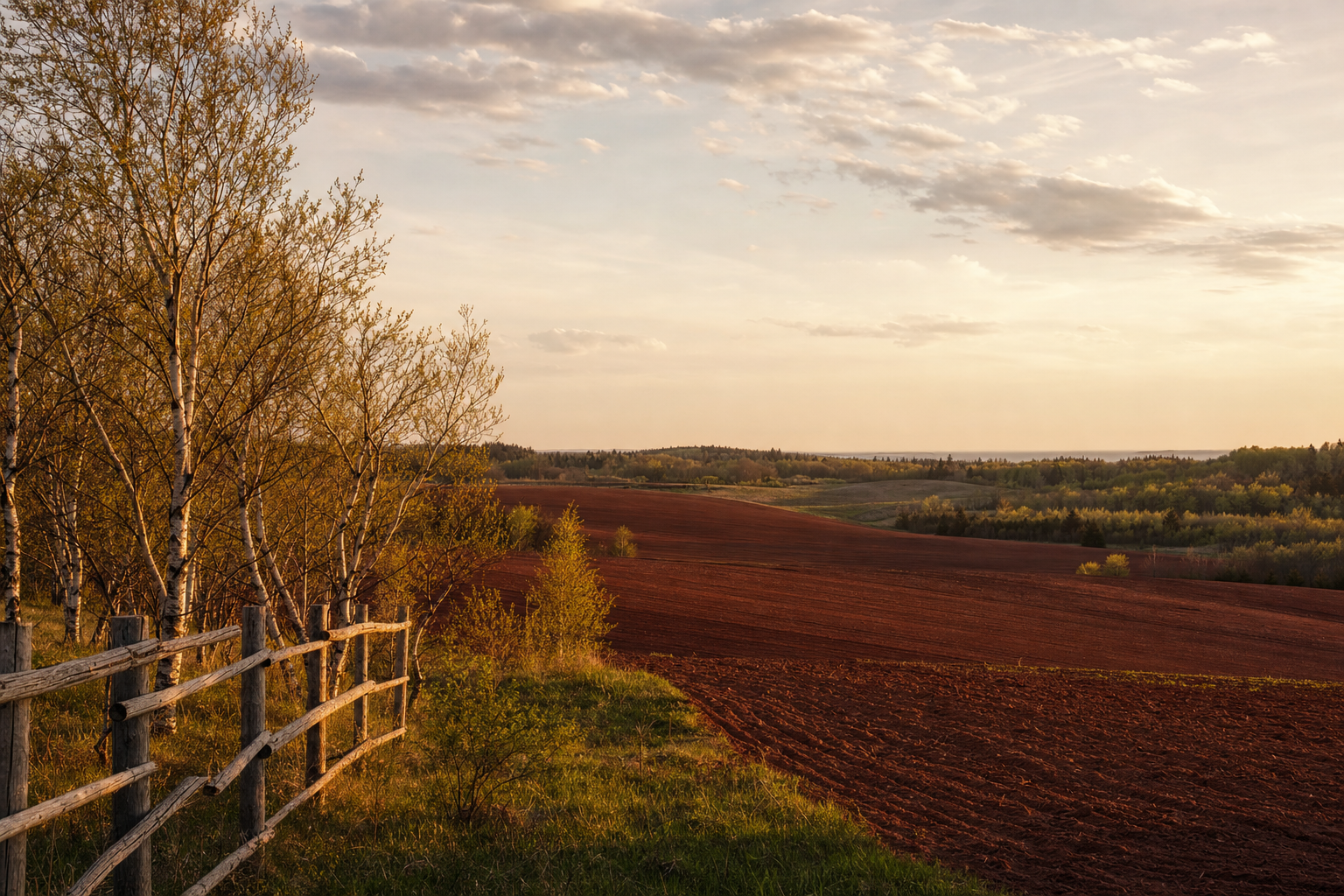
There is a week in late March on Prince Edward Island when the ground cannot decide what it is. In the morning it is frozen solid and rings underfoot like a drum. By afternoon the sun has done something to the surface layer, turning it to mud that pulls at your boots with a particular sucking reluctance. By evening it is hard again. If you walk across a field at dusk, each footprint left in the soft hour has crystallized by dark into a small monument of the day's indecision.
I grew up in Charlottetown and left for university in Halifax with the vague idea that getting away from a small island would give me more room to become whoever I was trying to become. It did, after a fashion. But when I came back in my late twenties - drawn by a relationship, then by the relationship's end, then by inertia that slowly became preference - I found that the island had accumulated a kind of pedagogical weight that I had not noticed while I was living inside it.
The seasons here are not a backdrop. They are a curriculum.
"The island had accumulated a kind of pedagogical weight that I had not noticed while I was living inside it."
The Refusal to Yield
When I returned to PEI, I was in what I would now describe as a high-resistance phase. I had strong opinions about how things should go and a pronounced unwillingness to adjust those opinions when reality differed. I treated the seasons the same way I treated everything else: as obstacles to be managed. Winter was something to be gotten through. Spring was late and imperfect. Summer was shorter than it ought to be.
The first signal that this approach was not working arrived in a garden. My grandmother kept a kitchen garden behind her house on the west side of the city, and she had given me a small plot when I moved back. I planted things too early because I was eager. I planted things too close together because I had plans. The garden responded with complete indifference to my reasoning. The tomatoes that went in the ground on May 15th suffered a night frost on May 22nd. The beans I crowded into a narrow row produced a tangle that yielded almost nothing.
My grandmother watched all this without comment for the better part of a summer. In September, when the garden had mostly vindicated its own judgment, she said something I have been sitting with since: "The garden doesn't care when you think it's ready. It cares when it is."
What Patience Actually Is
The word patience gets used in a way that I think flattens it into mere waiting. As though patience is simply the capacity to endure delay without complaint - a kind of gritted stoicism, white-knuckling through the calendar until the thing you want finally arrives.
Living with PEI's seasons has taught me that genuine patience is something more active. It involves learning to read conditions accurately enough that you stop fighting them. The farmers who have worked this land for generations do not merely wait out winters. They read them - the thickness of the ice on the harbour, the particular quality of the February thaw, the way the soil smells in April before it is ready. They are gathering information continuously, adjusting their plans against a constant incoming signal from the actual world.
This is different from acceptance in the passive sense. It is more like what environmental psychology calls sustained and specific attention. You cannot yield to a season you have not actually looked at.
The Dividend
I am writing this in late April. Outside my window, the red soil fields are finally drying enough that the tractor has been out. The lilac hedge along the property line is holding the first tentative green, the leaves still small and almost translucent, the purple clusters weeks away. Everything is in the particular suspended state that precedes the island's short and extravagant summer.
I have stopped trying to rush it. Not because I have achieved some serene enlightenment, but because the cost of rushing has become too familiar. The rushed version of spring is just a stressed one. The waited version - which is not really waiting but attending - gives you something different: the sudden sensory gift of a Tuesday in June when the lupins are out along the roadside and the light at eight in the evening is still pink and warm, and you notice all of it because you have been paying attention for months to the conditions that made it possible.
The rhythm of seasonal living is not a lifestyle choice in the consumer sense. It is a set of constraints that, when worked with rather than against, produce a particular kind of presence. The island imposes that rhythm whether you cooperate or not. The choice is only whether to learn from it.
Author
Sarah Jenkins
Charlottetown, PEI
Sarah Jenkins writes on seasonal rhythms, environmental psychology, and the practice of slow living on Canada's smallest province. Her work explores the intersection of landscape and human habit, and why place matters more than we tend to admit.
More from Sarah Jenkins